Legal note: The offenders were young persons. NewsForBC is not publishing names or identifying details protected by the Youth Criminal Justice Act. The article criticizes the ruling and legal regime while relying on public court and news records.
Who was the judge?
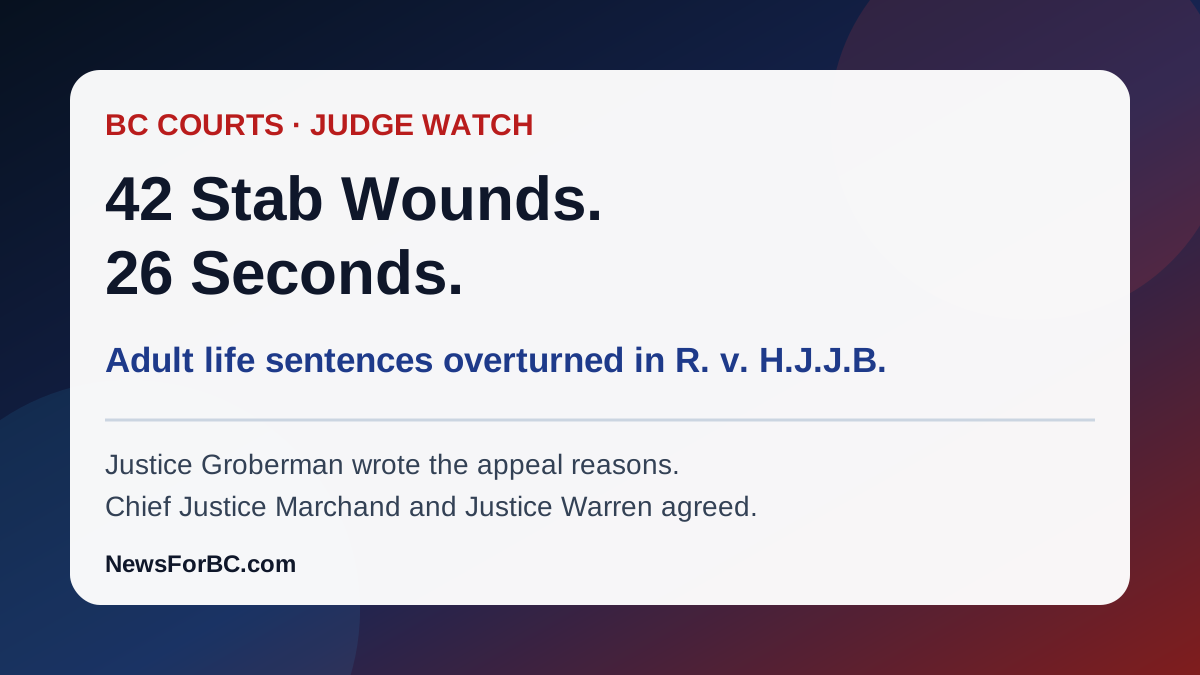
The appeal decision was R. v. H.J.J.B., 2026 BCCA 138, released March 27, 2026 by the B.C. Court of Appeal.
- Justice David F. Groberman wrote the reasons allowing the appeals and imposing youth sentences.
- Chief Justice Leonard Marchand agreed and formally pronounced the appeal allowed.
- Justice Susan Griffin Warren also agreed.
The original adult sentences came from the Provincial Court of British Columbia, Youth Division, in Surrey, dated November 4, 2022. The Court of Appeal decision did not name the Provincial Court trial judge in the public reasons reviewed by NewsForBC.
What happened to Paul Delphin Prestbakmo?
The facts are horrifying. The Court of Appeal said Paul Delphin Prestbakmo was killed in Surrey in the early hours of August 16, 2019. The two appellants were 15 and 16 at the time. The court described the killing as a brutal murder: forty-two stab wounds in 26 seconds, with wounds to the chest, abdomen, back, neck, arm and elbow, including fatal damage to vital organs.
The Court of Appeal said there was no apparent motive, no prior connection and no precipitating event. The judge below was left with the possibility that it was “simply a random act of extreme violence.”
Global News reported that Prestbakmo was a well-known Surrey mechanic who had been on his way to McDonald’s to get a pop near Semiahmoo Centre when he was killed. His sister Elizabeth Prestbakmo told Global News the reduced result felt “more of a slap on the wrist.”
The ridiculous part: the court knew the public would see injustice
Justice Groberman wrote: “I have no doubt that the brutality and senselessness of the crime in this case will cause some members of the public to view the overturning of the sentences as an injustice.”
That sentence should be read twice. The court knew the public would see it as an injustice. Then it did it anyway, because the legal framework boxed the court in.
The adult sentences were life imprisonment with seven years of parole ineligibility. The Court of Appeal replaced them with youth sentences: seven years total under s. 42(2)(q)(ii) of the Youth Criminal Justice Act, with the first four years in custody and the remainder under conditional supervision in the community, subject to credit for time already served after sentencing.
Why did the appeal court do it?
The answer is R. v. I.M., 2025 SCC 23, a Supreme Court of Canada decision released after the adult sentences were imposed. The B.C. Court of Appeal said I.M. substantially elevated the threshold for sentencing young persons as adults.
Before I.M., B.C. courts applied the B.C. Court of Appeal’s earlier framework in R. v. Chol. After I.M., the Crown had to prove beyond a reasonable doubt that the young person’s presumed diminished moral blameworthiness was rebutted. The Crown conceded that under I.M., the adult-sentence requirements were not made out in this case.
That is why this case is not only about three appeal judges. It is about the federal Youth Criminal Justice Act and a Supreme Court of Canada doctrine that can convert even a random 42-stab murder back into a youth-sentence maximum.
Judge Watch analysis
Justice Groberman’s reasons are careful, legalistic and openly constrained. The panel did not say the killing was minor. It did not pretend the facts were soft. It called the crime brutal and senseless. It acknowledged the public would see injustice. It still set aside the adult sentences.
That is exactly why the case is so corrosive to public confidence. When the law can look at 42 stab wounds, a random victim, lethal organ damage, a second-degree murder conviction and still say the maximum consequence is a youth sentence, the system is not merely “misunderstood.” It is asking ordinary people to accept a moral result they are not wrong to reject.
The court’s answer is: Parliament wrote the Youth Criminal Justice Act, the Supreme Court interpreted it, and lower courts must follow. That may be legally correct. But it is politically explosive. If Parliament and the Supreme Court have built a regime where this result is mandatory, then the public has every right to demand that the regime be changed.
What should be asked now
- Should youth offenders convicted of second-degree murder after extreme random violence be eligible for adult sentencing on a lower threshold?
- Should the Youth Criminal Justice Act allow longer custody for murder cases where rehabilitation evidence is weak?
- Should families be told that “accountability” can mean four years in custody after a random 42-stab killing?
- Should the public be able to see more sentencing reasons in youth murder cases without identifying protected youths?
- Will B.C.’s Attorney General ask Ottawa to amend the YCJA after this case?
Bottom line
The judge to watch is Justice Groberman, joined by Chief Justice Marchand and Justice Warren. But the deeper target is not only the panel. It is the legal machine that made the panel say a result it knew many people would view as unjust.
Paul Prestbakmo is dead. His name is public. His family carries the sentence for life. The killers’ identities remain protected because they were young persons. The public is told this is justice because the statute and Supreme Court doctrine say so.
That is not a public-confidence answer. That is a public-confidence crisis.