Evidence note: This article source-checks the public Facebook caption and visible frame text. The clip is treated as political advocacy, not as a primary legal source.
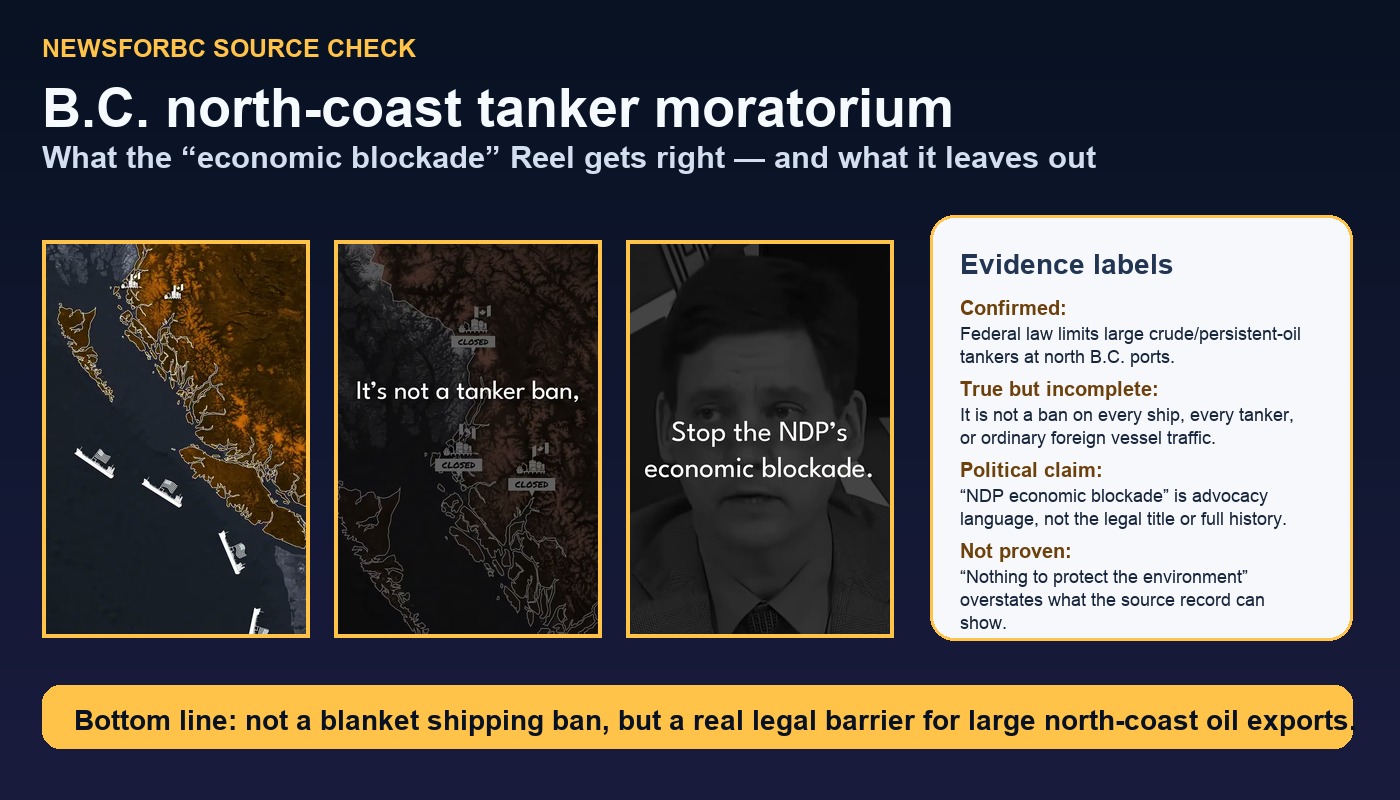
What the Reel says
The public Facebook caption says: “It's not a ‘tanker ban.’ It's an NDP economic blockade. Foreign ships still sail freely along B.C.'s northern coast. The only thing being blocked is our prosperity, while doing absolutely nothing to protect the environment.”
Visible frames reviewed by NewsForBC show stylized ship traffic on a coastal B.C. map, the phrase “It’s not a tanker ban,” several “CLOSED” labels near Canadian-flagged coastal icons, and the final slogan “Stop the NDP’s economic blockade.” The downloaded audio did not produce a usable spoken transcript.
What the law actually does
The underlying law is the federal Oil Tanker Moratorium Act, passed as Bill C-48 and given royal assent on June 21, 2019. Parliament’s LEGISinfo page identifies it as a House Government Bill sponsored by the Minister of Transport.
The statute is not a ban on every foreign ship, every tanker, every marine cargo, or every vessel movement along the B.C. coast. Section 4 targets a narrower category: an oil tanker carrying more than 12,500 metric tons of crude oil or persistent oil in bulk in its hold. Such a tanker is prohibited from mooring or anchoring at a port or marine installation in the defined northern B.C. area, and from unloading there. Loading is also prohibited if it would put the tanker over the threshold.
The Act defines the relevant B.C. coast as north of 50°53′00″ north latitude and west of 126°38′36″ west longitude. In practical terms, that is the north-coast tanker-moratorium zone often discussed in connection with northern export terminals and pipeline-to-port proposals.
What the Reel gets right
The Reel is right on one narrow point: calling it a simple “tanker ban” can be misleading if readers think all tankers, all ships, all foreign vessels, container ships, cruise ships, ferries, bulk carriers or LNG-related vessels are stopped from sailing along the northern B.C. coast. The law is targeted at large crude and persistent-oil tanker cargo movements involving ports and marine installations in the zone.
So the phrase “foreign ships still sail freely” points to a real distinction: the law does not close the coast to general vessel traffic. It limits a specific oil-export and oil-import pathway.
What the Reel leaves out
The “NDP economic blockade” label is political language. The legal record reviewed by NewsForBC does not identify the law as an NDP act. It was federal Bill C-48, a government bill sponsored by the Minister of Transport, passed in the 42nd Parliament and assented to in 2019. Parties can support, oppose or campaign around the law, but the source trail should not be replaced by a slogan.
The economic argument is also real but incomplete. The moratorium does block a class of large oil-tanker movements that would be needed for some north-coast crude export terminal models. That is why pipeline and energy-development supporters call it a barrier to prosperity. But the law does not by itself explain all constraints on B.C. ports, Indigenous consent, project financing, pipeline approvals, market access, spill response or environmental review.
The environmental claim is overstated
The Reel’s strongest unsupported line is that the law does “absolutely nothing to protect the environment.” The Act’s design is explicitly about reducing large crude and persistent-oil tanker activity at ports and marine installations on the north coast. Whether that is the best environmental policy is a fair political debate. But saying it does nothing erases the basic spill-risk rationale behind targeting large persistent-oil cargo movements in a sensitive marine region.
A more accurate sentence would be: the law may reduce one category of oil-spill risk in the north-coast port zone, while also restricting one route for major petroleum export projects. The public argument is about whether that tradeoff is worth it.
Evidence labels
- Confirmed: The Oil Tanker Moratorium Act is federal law and received royal assent on June 21, 2019.
- Confirmed: It restricts oil tankers carrying more than 12,500 metric tons of crude or persistent oil from mooring, anchoring, loading or unloading at ports or marine installations in the defined northern B.C. coastal area.
- True but incomplete: It is not a blanket ban on all ships or all foreign vessel traffic along the coast.
- Political framing: “NDP economic blockade” is advocacy language, not the statutory name or full legal history.
- Overstated: “Doing absolutely nothing to protect the environment” goes beyond what the record supports.
What B.C. should ask now
- If the moratorium stays, what energy, port and Indigenous economic opportunities are still realistic on the north coast?
- If Ottawa changes it, what spill-response, insurance, Indigenous-consent and marine-protection conditions would apply before any new project proceeds?
- What kinds of vessel traffic are actually operating in the zone today, and which proposed exports are blocked by the 12,500-tonne crude/persistent-oil threshold?
- Can political leaders describe the tradeoff honestly: environmental risk reduction versus foregone petroleum-export capacity?
NewsForBC view: the Reel is useful because it challenges a loose phrase — “tanker ban” — but it replaces one shortcut with another. B.C. readers need the precise legal threshold, the real economic barrier, and the environmental tradeoff in the same frame.