Evidence note: This article treats the Facebook screenshot as proof of what the post claimed, not proof the claim is true. No direct statement from Dr. Bonnie Henry responding to this exact Gail Macrae / David J Harris Jr. post was found in this review.
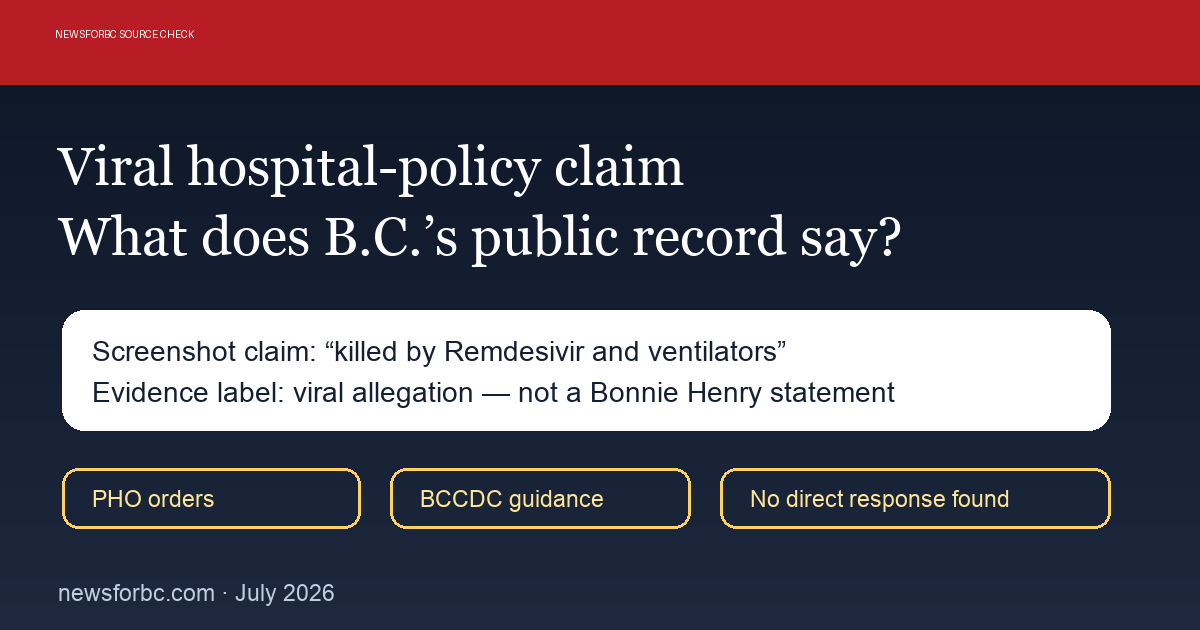
What the Facebook post says
The supplied screenshot shows a post shared in We The People of Western Canada. Inside the shared card, the source is the verified Facebook account David J Harris Jr. The post says:
“Whistleblower Gail Macrae, a registered nurse with years on the front lines, stated that zero patients died from COVID. She claimed they were killed by Remdesivir and ventilators.”
It continues by alleging hospitals were “half-empty,” that every “COVID label” meant “massive government bonuses,” that it was “murder for money,” and that patients came in with flu or pneumonia and left “in body bags after being poisoned and suffocated by hospital policy.”
Those are serious allegations. The screenshot does not show a B.C. hospital record, a B.C. coroner finding, a court ruling, a B.C. clinical order, or a statement from Dr. Bonnie Henry.
What Bonnie Henry says about this exact claim
NewsForBC did not find a direct Bonnie Henry response to this exact post or wording. Searches for Dr. Bonnie Henry with Gail Macrae, Remdesivir, ventilators, “murder for money” and “hospital policy” did not surface a public statement answering this specific viral claim.
That matters because the Facebook post is framed as a broad accusation against COVID hospital care. But it is not, in the visible screenshot, anchored to B.C. documents or a B.C. proceeding.
What B.C.’s official record shows
B.C.’s Office of the Provincial Health Officer COVID page says PHO orders must be followed and identifies the B.C. Centre for Disease Control as the source for comprehensive COVID information and guidance. The same page now notes the COVID-19 emergency order was rescinded on July 25, 2024 and the health-care-worker vaccine mandate has been lifted.
The B.C. record therefore does not read like the Facebook post. It is a record of public-health orders, archived guidance and clinical guidance links — not an admission that hospitals had a policy of poisoning or suffocating patients.
What BCCDC treatment guidance says about Remdesivir and ventilation
BCCDC’s current COVID treatment materials are conditional and severity-based. They do not say every patient with a positive test should receive the same drugs or respiratory support.
The April 2025 BCCDC in-patient algorithm says many people in hospital who test positive for SARS-CoV-2 are not hospitalized due to COVID-19 and do not require initiation of COVID-19 therapeutics. It also says patients who require oxygen or organ support often have other reasons for those interventions besides COVID-19, and clinicians should check that ventilator or organ support is required due to COVID-19 and not another indication.
For Remdesivir, the B.C. guidance is also more nuanced than the viral post. The April 2025 therapeutics summary says Remdesivir is not recommended in critical COVID-19 outside approved clinical trials because it has not demonstrated improved survival or time to recovery in that group. Other BCCDC materials describe Remdesivir or Paxlovid as options for selected higher-risk mild-to-moderate patients within time windows and clinical criteria.
What is confirmed, and what is not
- Confirmed: the supplied screenshot shows a David J Harris Jr. post quoting Gail Macrae’s claim.
- Confirmed: the post claims zero patients died from COVID and alleges deaths from Remdesivir, ventilators and hospital policy.
- Not confirmed: that the post is a Bonnie Henry statement or a B.C. official record.
- Not found in this review: a direct Bonnie Henry answer to this exact Gail Macrae / David J Harris Jr. post.
- Confirmed: B.C.’s PHO COVID page points to PHO orders, archived guidance and BCCDC resources.
- Confirmed: BCCDC guidance makes treatment decisions conditional on severity, risk, timing and whether COVID is actually the cause of oxygen or organ-support needs.
- Confirmed: current BCCDC materials say Remdesivir is not recommended for critical COVID outside approved clinical trials.
- Not supported by B.C. sources reviewed: the blanket claim that B.C. hospitals had a policy of poisoning and suffocating COVID-labelled patients.
Why the distinction matters
Families who lost loved ones during COVID are entitled to ask hard questions about isolation rules, communication, treatment decisions, adverse events, hospital capacity, and whether government orders were proportionate. Those are legitimate public-interest questions.
But the Facebook post makes a much broader allegation: that patients did not die from COVID and were murdered for money by hospital policy. That allegation requires records, case files, expert testimony and jurisdiction-specific evidence. The screenshot alone does not provide that evidence.
A careful B.C. version of the question is narrower and stronger: What did B.C. hospitals actually do, under which PHO orders and clinical guidance, and what do patient records, adverse-event data and mortality reviews show?
Questions B.C. officials should answer clearly
- How many B.C. hospitalized COVID-positive patients were treated primarily for COVID-19 versus another admitting diagnosis?
- How often were Remdesivir, dexamethasone, tocilizumab, baricitinib, non-invasive ventilation and invasive ventilation used by wave and health authority?
- What adverse-event monitoring was done for Remdesivir and other COVID therapeutics?
- How were family-visit restrictions balanced against patient advocacy and end-of-life care?
- What has B.C. changed since 2020–2022 in hospital COVID treatment and patient communication?
NewsForBC view: the viral post is not enough to prove its claim. But the public deserves plain-language answers on COVID hospital policy, treatment guidance, family isolation rules and how B.C. changed course over time.
Source trail
- User-supplied Facebook screenshot preserved by NewsForBC.
- NewsForBC source note and evidence labels.
- B.C. Office of the Provincial Health Officer: COVID-19 page.
- BCCDC: COVID-19 treatments page.
- BCCDC: In-patient Algorithm for Management of COVID-19, April 2025 PDF.
- BCCDC: Summary of Key Therapeutics for Adults with COVID-19, April 2025 PDF.
- BCCDC: Health Care Provider Information on Paxlovid and Remdesivir, April 2025 PDF.