Editorial note: The Financial Times page was subscription-locked in NewsForBC’s capture. The accessible public text confirmed the headline, URL and publication time, but not the full article body. This piece therefore uses the FT headline as the news peg and verifies the surrounding Canada-UAE investment context through accessible official sources.
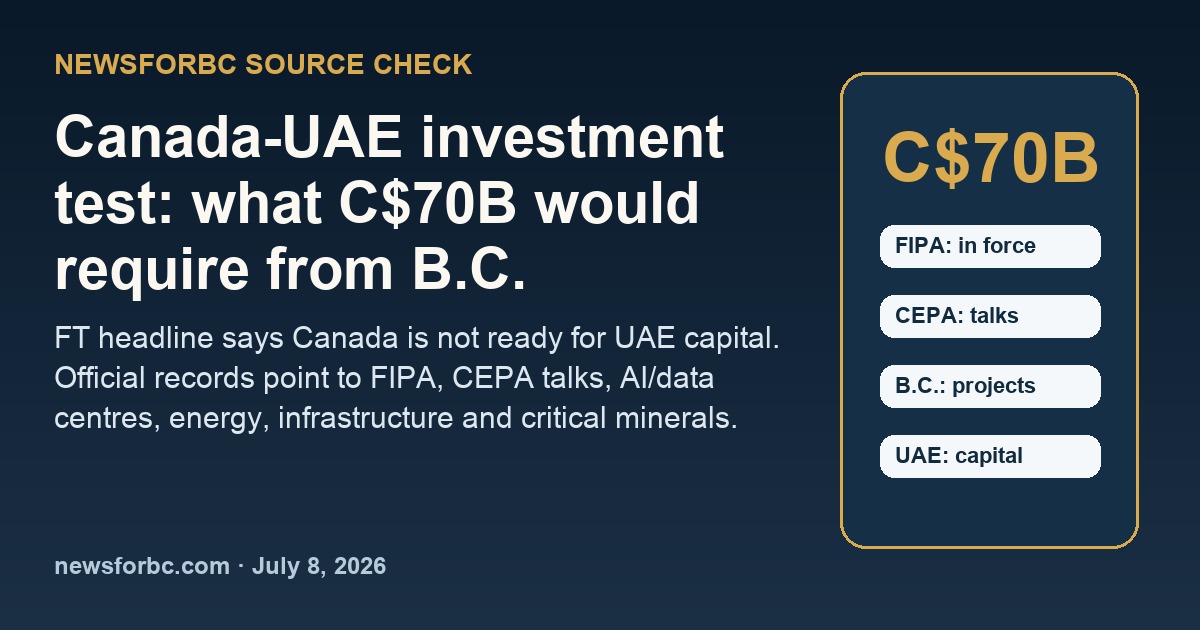
The Financial Times published a July 7 article under the headline: Canada tells UAE it is not ready for its C$70bn investment. NewsForBC could not access the full FT article text through the public page, but the headline alone is a major enough signal to check against Canada’s official UAE files.
Those official records show the Canada-UAE relationship has been moving quickly: a prime-ministerial visit to the UAE in November 2025, a Foreign Investment Promotion and Protection Agreement now in force, an intention to launch free-trade-style CEPA negotiations, an AI/data-centre cooperation file, and explicit priority sectors that overlap heavily with British Columbia — energy, infrastructure, critical minerals, ports, technology and natural resources.
Bottom line
The FT headline is best read as a capital-readiness warning. Canada has been courting UAE capital, but B.C. projects will only benefit if governments can produce bankable, permitted, power-ready and Indigenous-partnered projects at investment scale.
For B.C., the question is not simply whether the UAE has money. It is whether LNG, critical minerals, electricity transmission, port expansion, AI/data-centre infrastructure and major-resource projects can move from announcement to investable reality.
What official records confirm
- Canada-UAE ties are deepening. Global Affairs Canada says 2024 marked 50 years of diplomatic relations and that the 2025 prime-ministerial UAE visit was the first by a Canadian prime minister in more than 40 years.
- Trade is already material. Global Affairs lists 2025 two-way merchandise trade with the UAE at $3.5 billion, including $2.8 billion in Canadian exports and $670.2 million in imports.
- The UAE has sovereign wealth funds looking beyond fossil fuels. Canada’s UAE relations page says UAE sovereign wealth funds are being used to diversify the economy and create opportunities in energy, ICT, infrastructure, healthcare, retail, education and other sectors.
- FIPA is now in force. Canada says the Canada-UAE Foreign Investment Promotion and Protection Agreement entered into force on May 19, 2026, creating clearer rules and protections for investors and a more predictable environment for two-way investment.
- CEPA talks are intended. Canada and the UAE announced an intention to launch negotiations toward a Comprehensive Economic Partnership Agreement during the 2025 leadership visit.
- AI and data centres are part of the file. Canada’s October 2025 Gulf visit announcement says Canada and the UAE signed an MoU to boost collaboration in artificial intelligence and data-centre infrastructure.
The B.C. angle: where C$70B would have somewhere to go
If the FT-reported number is treated as a potential investment target rather than a completed commitment, British Columbia has several files that fit the Canada-UAE priority list.
- LNG and energy infrastructure: B.C. is central to Canada’s Pacific energy-export strategy. Any new LNG, gas, power or port-linked project needs permitting certainty, First Nations partnerships, grid planning and long-term offtake logic.
- Critical minerals: Canada markets natural resources and critical minerals to global investors. B.C. has mineral potential, but mines and processing facilities require long timelines, power, roads, ports, tailings approvals and community consent.
- Ports and trade corridors: UAE-linked capital is highly familiar with ports and logistics. B.C.’s Pacific gateway is the practical route for Asia-facing trade, but port capacity, rail bottlenecks and land-use conflict matter.
- AI/data centres: Canada-UAE AI and data-centre cooperation points directly to electricity, cooling, land and fibre requirements. In B.C., that means BC Hydro capacity, local-government siting, environmental review and community benefit.
- Indigenous equity and benefit structures: Any major B.C. infrastructure file now needs real Indigenous participation, not after-the-fact consultation. That can be a strength if structured early, or a blocker if treated as a checkbox.
Why “not ready” would matter
Large sovereign and institutional investors do not only look for resources. They look for projects that are legally clear, politically durable, permitted, financed, insured and executable. If Canada cannot show a reliable pipeline of investable projects, capital can move elsewhere.
That is especially important for B.C. because many of the province’s biggest opportunities sit at the intersection of federal law, provincial approvals, Indigenous rights, municipal land-use decisions, electricity planning and global commodity cycles. A project can be attractive on paper and still be uninvestable if timelines, appeal risks and regulatory conditions are unpredictable.
What B.C. should ask now
- Which B.C. projects are actually ready for foreign institutional capital today?
- Which projects have permits, power, land, Indigenous partnership structures and offtake demand?
- Where is Canada asking UAE capital to go: LNG, mining, transmission, ports, hydrogen, AI/data centres, housing infrastructure or all of the above?
- Who is coordinating between Ottawa, Victoria, First Nations, municipalities and project proponents?
- Will any public money or guarantees be required before private/UAE capital participates?
- Will project benefits be visible in B.C. jobs, revenues, community infrastructure and Indigenous equity, or mostly in financial headlines?
Bottom line for NewsForBC readers
The FT headline should not be read as proof that C$70 billion is sitting in a cheque ready to be deposited into Canada. It should be read as a test: Canada has opened the door to UAE investment, but the country still has to prove it can turn major-project ambition into investable projects.
For British Columbia, that test is immediate. If Canada wants sovereign capital for energy, critical minerals, ports, AI infrastructure and trade corridors, B.C. will be one of the places where the country either proves it is ready — or proves the FT headline right.