Editorial note: This article checks a public YouTube commentary against Parliament of Canada bill records. It does not treat the commentary’s strongest claims — including claims about a redacted memo and future legal action against online users — as proven unless an accessible primary source supports them.
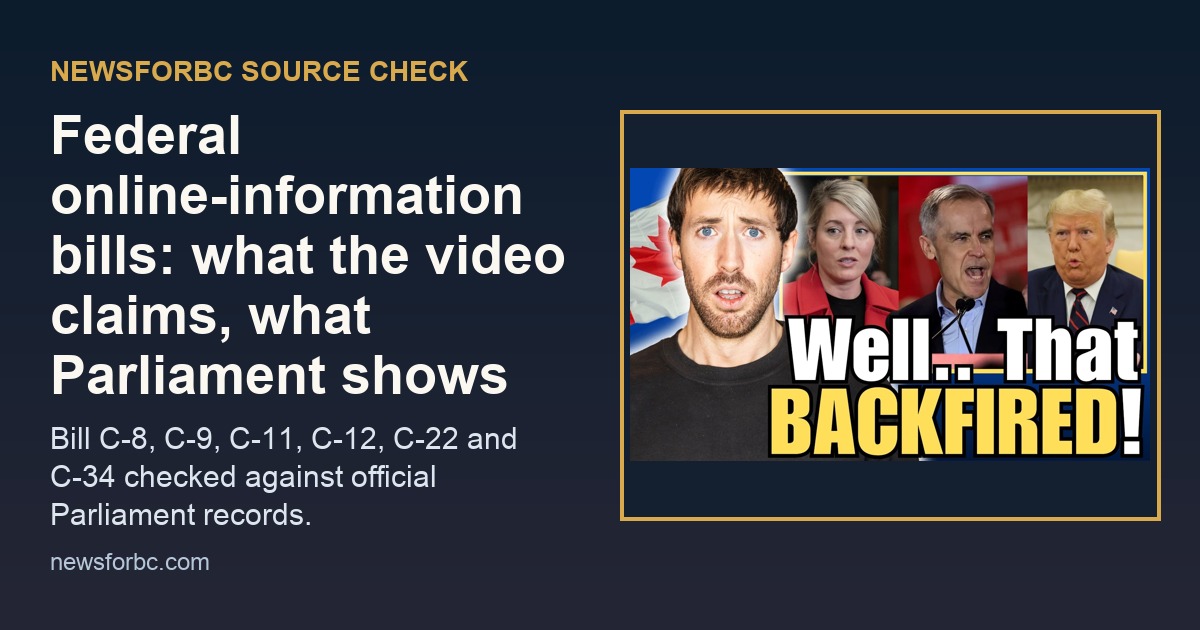
The video NewsForBC reviewed is a 23-minute commentary from The Right Call – with Elliot Daigneault titled Carney Wants to IMPRISON Canadians For Doing This… A SECRET Memo Reveals. The video says a “heavily redacted 35-page draft memo” from Industry Minister Mélanie Joly’s department calls for “preventing, detecting, and responding to false information” on platforms such as Facebook, X and LinkedIn, including “potential legal actions” with senior approval.
The video then links that alleged memo to Bill C-8, Bill C-9, Bill C-11, Bill C-12, Bill C-22 and Bill C-34, saying the bills “all make sense” as part of a wider information-control push. That is the claim this source-check reviews.
Bottom line
Several of the bills are real and directly relevant to privacy, cyber security, lawful access, hate-crime enforcement or social-media safety. But the list also includes bills whose official titles are not primarily about online speech. The video’s broad claim of a single coordinated plan to imprison Canadians for sharing information is not established by the public bill record alone.
The public-interest issue is still serious: B.C. readers should understand how federal cyber, lawful-access, hate-crime and digital-safety laws can affect speech, platform duties, online anonymity, privacy and enforcement. But the strongest version of the viral claim needs more evidence than the video provides.
The six bills named in the video
- Bill C-8 — cyber security and telecommunications. Parliament lists C-8 as An Act respecting cyber security, amending the Telecommunications Act and making consequential amendments to other Acts. LEGISinfo says it received royal assent on June 15, 2026. This bill belongs in the cyber-security / telecom-security file, not simply an “online speech” file.
- Bill C-9 — the Combatting Hate Act. Parliament lists C-9 as an act to amend the Criminal Code on hate propaganda, hate crime and access to religious or cultural places. LEGISinfo says it received royal assent on June 18, 2026. This is directly relevant to speech-related criminal law, but it is not automatically a general misinformation law.
- Bill C-11 — military justice. Parliament lists C-11 as the Military Justice System Modernization Act, amending the National Defence Act and other acts. LEGISinfo says it received royal assent on June 18, 2026. Based on the official title and bill page, this is not an online-information bill.
- Bill C-12 — immigration and border security. Parliament lists C-12 as the Strengthening Canada’s Immigration System and Borders Act. LEGISinfo says it received royal assent on March 26, 2026. It may matter for border and immigration policy, but the official bill page does not make it an online-speech bill.
- Bill C-22 — lawful access. Parliament lists C-22 as the Lawful Access Act, 2026. At capture time, LEGISinfo listed it as a House of Commons bill awaiting first reading in the Senate after House third reading on June 18, 2026. This is one of the bills most relevant to privacy, digital access and surveillance concerns.
- Bill C-34 — the Safe Social Media Act. Parliament lists C-34 as a bill to enact the Digital Safety Act and the Digital Safety Commission of Canada Act. LEGISinfo listed it at second reading in the House after introduction on June 10, 2026. This is directly relevant to platform regulation and social-media governance.
What the video is right to put on the public radar
The video is right that Canadians should watch the combination of cyber-security law, lawful-access proposals, hate-crime changes and social-media regulation. These files can interact in ways that affect ordinary users: what platforms must remove, when identity information can be sought, how anonymous accounts are treated, how speech offences are investigated and who defines “harmful” or “false” information.
Those are not fringe questions. They are civil-liberties, privacy and democratic-accountability questions. For B.C. readers, they affect journalists, independent commentators, activists, local-news pages, small businesses, parents, youth, religious communities and political groups who use national platforms every day.
Where the video overreaches
The video moves quickly from “there is a memo and there are bills” to “the government is gearing up for war with its citizens.” That may be commentary, but it is not the same as a documented legal finding.
NewsForBC captured the video transcript and metadata. During this review, the underlying 35-page memo was not available in the public source trail captured with the YouTube video. That means the article can report what the video says about the memo, but should not independently state that the memo proves a plan to imprison Canadians for online posts.
There is also a precision problem in the bill list. C-8, C-9, C-22 and C-34 are plausibly part of a digital-security / online-enforcement conversation. C-11 and C-12, based on their Parliament titles and LEGISinfo pages, are primarily military-justice and immigration/border bills. Lumping all six together as one online-censorship package blurs important distinctions.
The lawful-access and encryption concern
The video’s most concrete policy concern is Bill C-22. The commentary says lawful-access powers could put encryption at risk or create technical access paths that governments and hackers could exploit. That is a serious debate in any democratic country: law-enforcement access, encryption security, judicial oversight, platform obligations and abuse safeguards all need public scrutiny.
But the right way to cover it is clause-by-clause, not slogan-by-slogan. If the bill authorizes production orders, subscriber-information access, technical-assistance duties or data-preservation rules, readers need to know the thresholds, warrant requirements, reporting obligations and privacy safeguards. NewsForBC will continue to watch C-22 as it moves through the Senate.
The hate-crime and digital-safety concern
Bill C-9 and Bill C-34 raise a different set of questions. Hate propaganda, threats and intimidation are already recognized legal categories. Digital-safety regulation can also target real harms, including exploitation, harassment and content that affects children. The challenge is how to do that without giving government or regulators broad discretion to punish lawful political disagreement, unpopular opinion or good-faith reporting.
That is where legislative detail matters: definitions, thresholds, appeal rights, transparency reports, independent review, Charter scrutiny and clear separation between illegal content and merely disputed opinion.
What B.C. readers should ask MPs and senators
- Which provisions, if any, require platforms or service providers to identify users?
- What judicial authorization is required before subscriber information, metadata or content can be obtained?
- Do any provisions require companies to weaken encryption or build technical access mechanisms?
- How are “harmful,” “false,” “misleading,” “hate” and “safety” terms defined?
- What remedies exist if government, police, a regulator or a platform overreaches?
- Are journalists, independent media, political commentators and local-news publishers protected from vague enforcement?
- Will annual transparency reports show how often powers are used, by whom and for what categories of cases?
Bottom line for NewsForBC readers
The video is useful as a warning flag, not as a complete source by itself. The public record confirms that multiple federal bills touch cyber security, hate-crime enforcement, lawful access and social-media safety. It does not, on its own, prove a single secret plan to imprison Canadians for ordinary online disagreement.
The responsible conclusion is this: Canadians should demand detailed scrutiny of C-8, C-9, C-22 and C-34, especially around privacy, encryption, identity, online speech and oversight. But the public should also avoid treating every bill in the video’s list as the same kind of speech-control law.