The short answer
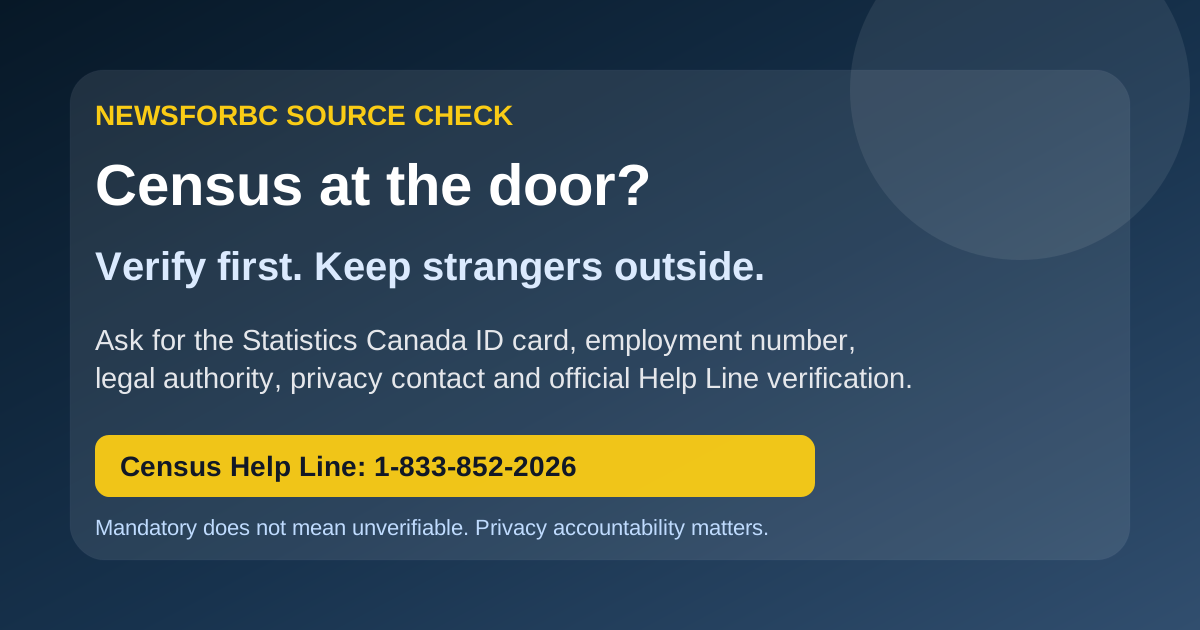
Yes, residents can and should demand verification before giving personal information at the door. A legitimate census employee should be able to identify themselves and explain the legal authority, purpose and privacy protections for the collection. Statistics Canada’s own 2026 census FAQ says every census employee has an identification card with the Statistics Canada identifier, their name, employment number and photo. It also says residents can verify a census employee’s identity by calling the Census Help Line at 1-833-852-2026.
But there are limits to what residents can demand. A resident can demand enough information to verify authority. That does not necessarily mean the individual worker must hand over a driver’s licence, home address, background-check file, personnel record or training certificate at the doorstep. Those documents may contain the worker’s own personal information.
What a resident can reasonably demand before answering
- Official identification: name, photo, employment number and Statistics Canada identifier on the census employee card.
- Independent verification: the right to call the official Census Help Line before answering or continuing.
- Legal authority: confirmation that the request is being made under the Statistics Act.
- Purpose: what information is being collected and why it is needed for the census.
- Privacy explanation: how the information is protected, who can see it and what secrecy obligations apply.
- Alternative completion method: the ability to complete the questionnaire without letting a census employee inside the home.
- Complaint/privacy contact: where to report concerns about the visit, the worker or the collection process.
What Statistics Canada itself says
Statistics Canada’s 2026 census homepage states that answers are collected under the authority of the Statistics Act and kept strictly confidential. It also states that, by law, every household must complete a 2026 Census of Population questionnaire.
Its security and privacy FAQ says information is protected by the Statistics Act and the federal Privacy Act. It says Statistics Canada has strict rules to safeguard data holdings and that all Statistics Canada employees take an oath under the Statistics Act to protect information. The oath continues after employment ends and is backed by penalties.
For doorstep verification, Statistics Canada says every census employee has an identification card showing the Statistics Canada identifier, name, employment number and photo. If a resident wants to verify that person, Statistics Canada says they can call the Census Help Line at 1-833-852-2026.
You do not have to let a census worker into your home
This point matters. Statistics Canada’s FAQ says residents are not required to let census employees into their home. It says the census can be completed without letting anyone inside, including with the census employee at the door.
That means a B.C. household can draw a firm privacy boundary without pretending the census does not exist. The reasonable position is: verify first, keep the conversation at the door, use the official online questionnaire or help line where possible, and do not disclose extra information outside the questionnaire.
What the law requires of census employees
Section 6 of the Statistics Act requires the Chief Statistician and every person employed or deemed employed under the Act to take an oath or solemn affirmation before entering duties. The oath says they will fulfill their duties under the Act and will not disclose matters that come to their knowledge through employment without authority.
Section 17 prohibits disclosure of identifying information obtained under the Act, except in limited statutory circumstances. Section 30 makes it an offence for a sworn person to desert duty, make false declarations, seek information they are not authorized to obtain, or contravene the confidentiality rule.
In plain language: census workers and Statistics Canada do carry legal confidentiality obligations. That is not just customer-service language; it is statutory.
The uncomfortable part: the census is still mandatory
Residents should not confuse verification rights with a right to ignore the census entirely. Section 23 of the Statistics Act says a person who receives a mandatory request for information must provide it to Statistics Canada by the required time. Section 31 makes refusal or neglect to provide requested information, without lawful excuse, an offence punishable by a fine of up to $500. Section 32.1 removes imprisonment as punishment for convictions under sections 31 or 32.
That does not mean a resident must answer a stranger immediately on the doorstep. It does mean the safer pushback is procedural, not total refusal: “I will complete it through an official verified channel.”
Should residents be compensated — can you bill the government?
For ordinary census participation, NewsForBC found no clear legal basis for a household to invoice the federal government for time spent completing a mandatory census questionnaire. The Statistics Act provides for remuneration of commissioners, enumerators and other persons employed under the Act. It does not appear to create a general payment right for respondents who complete mandatory census forms.
There is a fair policy debate here. Government asks residents for time, attention and personal information. Residents are expected to absorb that cost. In an era when personal data has economic value, it is reasonable to ask whether public agencies should provide clearer service standards, privacy receipts, shorter questionnaires, stronger opt-in choices for linkages, or a credit/compensation model for extraordinary data demands.
But as a legal matter, a household should not assume that sending an invoice will create a debt the government must pay. It may be a protest tactic, not an enforceable bill.
What B.C. residents should say at the door
The chain-of-custody question: where does the card go?
Residents should also ask a practical question that is too often missing from government scripts: what is the chain of custody for any card, notice, access-code document or paper questionnaire that touches my household?
If a yellow card, access-code notice, paper form or completed questionnaire is used, residents should be able to get a plain-language answer to the data lifecycle:
- Who issued the card or notice?
- What information is printed on it, and does it identify the household?
- Who is allowed to collect, view, photograph, scan, enter, transport or store it?
- Where is it delivered — Statistics Canada, a regional office, a contractor, a scanning centre or another processing location?
- Is the information entered into a device at the door, keyed later, scanned, or mailed?
- What audit trail records who handled it and when?
- How long is the paper/card/notice retained?
- How is it destroyed or de-identified when no longer needed?
- What happens if it is lost, photographed, misdelivered or seen by the wrong person?
There is a reasonable security limit: government may not publish exact secure-facility layouts, internal routing details or staff security files. But it should provide the policy-level chain of command and chain of custody: the responsible agency, the role of any contractors, the class of storage/processing location, the retention/destruction rule, the privacy officer contact and the breach-reporting path.
The core demand is simple: if government says the public must trust the process, then the public should be able to understand the process.
What government should be required to prove
NewsForBC’s position is that lawful collection is not enough. Public agencies asking for sensitive household data should be able to prove the following in plain language:
- the exact statutory authority for the collection;
- the exact information required versus optional;
- the minimum data necessary for the public purpose;
- the identity and authority of any field worker;
- the privacy oath, confidentiality law and breach consequences;
- where the data is stored, at least at a high level;
- whether data can be linked with tax, immigration, benefits, survey or administrative records;
- how long identifiable information is retained;
- how a resident can complain or report suspicious conduct;
- how vulnerable residents can complete the process without pressure at the door.
The accountability line
Canadians should not be mocked for asking hard questions about data collection. A government that demands household information must be prepared to identify its agents, explain its authority, protect the information and accept scrutiny. “It is mandatory” is not a substitute for privacy accountability.
The strongest resident response is not paranoia and not blind compliance. It is verified compliance: confirm the worker, confirm the channel, answer only what is legally required, keep strangers outside the home, and report anything that feels coercive, unclear or unofficial.