Editorial note: This article source-checks a Facebook reel from Edison Motors. Profanity in the video is not repeated except where necessary for context. Claims about Edison’s own electrical hookup are attributed to the speaker; public policy figures are checked against government, CBC, TELUS and Energy Futures Institute sources.
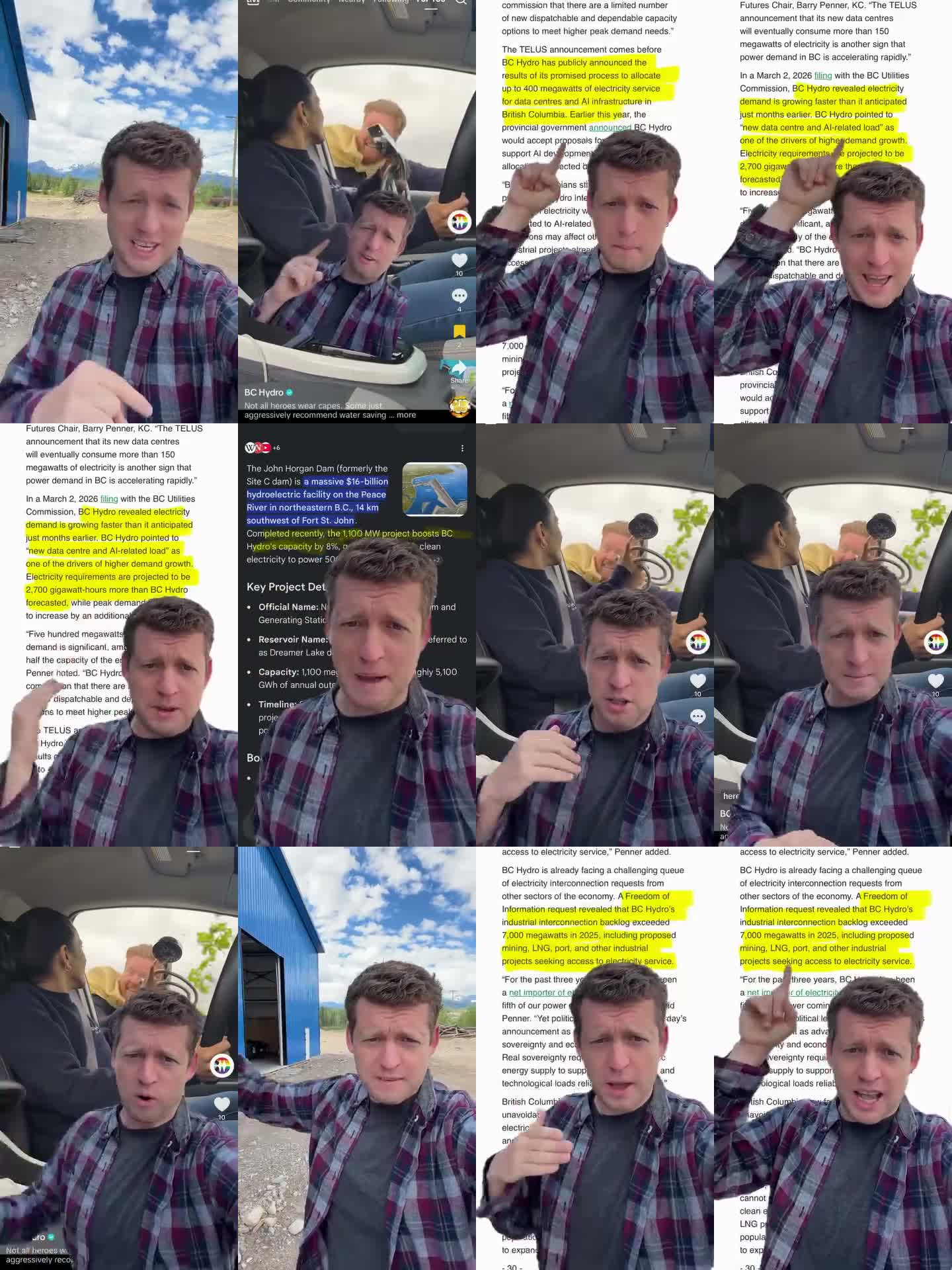
The reel’s argument is simple: BC Hydro asks ordinary people to conserve with measures such as low-flow showerheads while the province prepares to allocate large blocks of electricity to AI and data-centre projects. The tone is angry, but several underlying numbers are real enough to deserve public scrutiny.
What is confirmed
The B.C. government announced a competitive process for artificial-intelligence and data-centre projects, saying allocation targets are for as much as 400 megawatts over the first two years. CBC reported the same first tranche and noted Energy Minister Adrian Dix described 400 MW as about 35 per cent of Site C power.
TELUS announced a B.C. sovereign AI infrastructure cluster across three facilities, saying the cluster will scale to more than 60,000 GPUs and 150 MW by 2032. CBC separately reported the TELUS project would begin with an 85 MW power draw and scale up to 150 MW by 2032.
Those are large numbers in a province where power access is already a public-policy constraint. The public question is not whether data centres are inherently bad. It is whether B.C. has a clear, transparent framework for comparing AI compute against other electricity users that also claim economic, employment or climate benefits.
What needs attribution
The reel also says Edison Motors is waiting for an electrical interconnection and is using a diesel generator to power operations. NewsForBC is treating that as the speaker’s own claim, not as an independently verified BC Hydro service record. Edison Motors’ public website confirms it is a B.C.-based diesel-electric truck company, but the hookup status would require company and/or BC Hydro documentation to verify fully.
The reel’s 2,700 GWh and 7,000 MW figures appear in an Energy Futures Institute article by former B.C. environment minister Barry Penner. That article says a March 2, 2026 BC Utilities Commission filing showed electricity requirements 2,700 GWh higher than forecast and an additional 500 MW of peak demand, and says an FOI request showed a 7,000 MW industrial interconnection backlog in 2025. NewsForBC links the article and labels those as Energy Futures claims unless readers inspect the underlying BCUC and FOI records.
The accountability question for B.C.
B.C. is trying to electrify transportation, industry and buildings while also attracting AI/data-centre investment. That creates a genuine trade-off: if clean electricity is scarce, who gets connected first, on what terms, and with what public benefit test?
A credible power-allocation framework should publish more than slogans. It should show project-by-project megawatts, expected jobs, public revenue, First Nations participation, emissions effects, water use, backup-generation needs, grid-upgrade costs and timelines for connection. It should also say how household conservation fits into the bigger picture.
NewsForBC view: B.C. residents should not be asked to accept household sacrifice without a transparent industrial-power ledger. If AI data centres get hundreds of megawatts, the province should publish exactly what British Columbians receive in return — and how those allocations affect mines, ports, manufacturers, housing electrification and small employers waiting in the queue.
Source trail
- Edison Motors Facebook reel: “AI data centres for Billionaires while the rest of us suffer??”.
- B.C. Government release: AI/data-centre competitive process and up to 400 MW allocation target.
- CBC: “AI, data centre companies will have to compete for electricity in B.C.”.
- TELUS release: B.C. sovereign AI infrastructure cluster, 60,000 GPUs and 150 MW by 2032.
- CBC: Vancouver/Kamloops AI data-centre plan and 85 MW to 150 MW power draw.
- Energy Futures Institute: TELUS data-centre plans and BC Hydro supply-gap questions.
- BC Hydro: showerheads and faucets conservation page.
- BC Hydro: Site C Clean Energy Project.
- NewsForBC source note, transcript and capture summary.
- Retrieved Facebook reel transcript.