Evidence note: this article does not say any retailer broke the law. NewsForBC captured the YouTube metadata and transcript, then checked the claims against public Canadian Food Inspection Agency labelling guidance. NewsForBC did not independently buy samples, test meat, inspect package lot codes, or obtain the lab reports behind the video.
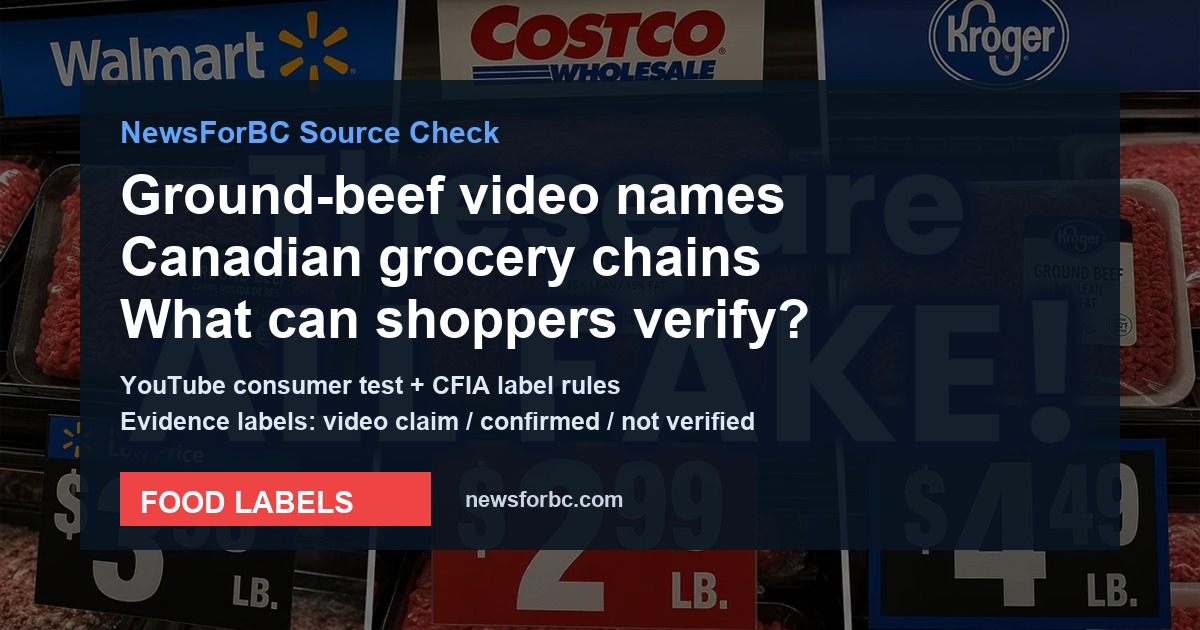
The YouTube video, titled “We Tested Ground Beef From Costco, Walmart, Loblaws, Sobeys & 8 More Canadian Stores | Most Failed,” was posted by Broken Canada on July 8, 2026. The video claims ground beef was bought from Costco, Walmart, Loblaws, Sobeys, No Frills, Food Basics, Metro, FreshCo, Safeway, T&T Supermarket and an independent butcher used as a control.
The video’s central claim is not simply that some beef tasted worse. It says the concerning gap was in cook-down loss, render liquid, fat/water ratio, colour/oxidation and label/lab cross-checks. The video says Food Basics and No Frills were among the worst, Walmart performed poorly in the pan despite being within fat-label tolerance, Safeway and Costco performed well, and the independent butcher performed best.
That is exactly the kind of viral consumer claim that needs two labels at once: worth investigating and not proven as a representative chain-wide finding from the video alone.
What the video says it tested
The transcript says the test used four checks: cook-down weight loss, separation of rendered fat and water, colour/oxidation inspection after opening, and a label-accuracy cross-reference. It also says samples from six stores were sent to an independent food-testing laboratory for basic nutritional composition analysis.
Those claims matter, but the video does not publish the full raw data package inside the YouTube description reviewed by NewsForBC. There are no lot codes, package photos, lab certificates, store addresses, duplicate samples, or retailer responses included in the captured source set. That means the video can raise a public-interest question, but it should not be treated like a CFIA enforcement finding.
What CFIA rules confirm
The Canadian Food Inspection Agency’s public meat-labelling guidance confirms one key fact: ground-meat common names are tied to maximum fat content. CFIA lists:
- Regular Ground — maximum 30% fat;
- Medium Ground — maximum 23% fat;
- Lean Ground — maximum 17% fat;
- Extra Lean Ground — maximum 10% fat.
That supports the basic idea that “lean,” “medium” and “extra lean” are regulated categories, not just marketing words.
CFIA guidance also discusses meat and poultry products with added water or food additives, retained-water declarations for raw single-ingredient meat products, and minimum meat-protein declarations in some added-water/phosphate contexts. That makes the video’s water-and-protein framing a legitimate consumer-label topic — but it also means the rules are technical. A viral video cannot replace package-by-package regulatory review.
What is not verified
- Not independently verified: the video’s claimed cook-down percentages, water/fat ratios, protein findings, and store rankings.
- Not proven: that a named chain’s entire Canadian ground-beef supply has the same result as one sampled package or shopping trip.
- Not a recall: NewsForBC found no CFIA recall or public food-safety alert in this review tied to the video’s specific claims.
- Not a legal finding: no retailer violation is established by the YouTube video alone.
What B.C. shoppers can do now
The practical takeaway is not panic. It is documentation.
- Photograph the full package: front label, Nutrition Facts, ingredient list if present, pack date, best-before date, lot code and store receipt.
- Weigh the raw portion and the cooked portion if you are concerned about extreme shrinkage.
- Save photos of unusual liquid, smell, colour or packaging problems.
- Ask the store whether the beef was ground in-store or supplied pre-ground, and whether sourcing information is available.
- If the issue is incorrect labelling, food fraud or misrepresentation, use CFIA’s complaint pathway or the relevant provincial/local authority depending on the issue.
For families already squeezed by grocery prices, the important consumer question is not whether one YouTube ranking should become law. It is whether shoppers can compare real value: how much edible cooked meat remains, what the fat category actually means, whether water/processing affects the purchase, and whether origin/sourcing language is clear enough.
NewsForBC view
The Broken Canada video should be treated as a source-card lead, not a verdict. But it hits a real accountability gap: Canadians are paying more for groceries while many labels still require expert reading to understand what is actually being bought.
If retailers are confident in their ground-beef programs, they can answer with batch data, supplier standards, lab summaries and plain-language sourcing explanations. If regulators are confident the rules are strong enough, they can show shoppers how those rules are tested and enforced. The worst answer is silence while families guess from colour, price and brand trust.
Evidence labels
- Confirmed: YouTube metadata/title/channel/duration and transcript contents were captured by NewsForBC.
- Confirmed by CFIA guidance: Canadian ground-meat fat-category names correspond to maximum fat levels.
- Public-interest issue: added water, retained water, meat protein and label clarity are real regulatory topics in CFIA guidance.
- Not independently verified by NewsForBC: the video’s raw testing results, lab certificates and chain-wide rankings.
- Consumer path: CFIA’s complaint tool includes incorrect labelling, food fraud or misrepresentation as a reportable concern pathway.